Projects

Research, Modelling and Data

Selected work across deep learning, environmental monitoring, remote sensing, and scientific software.

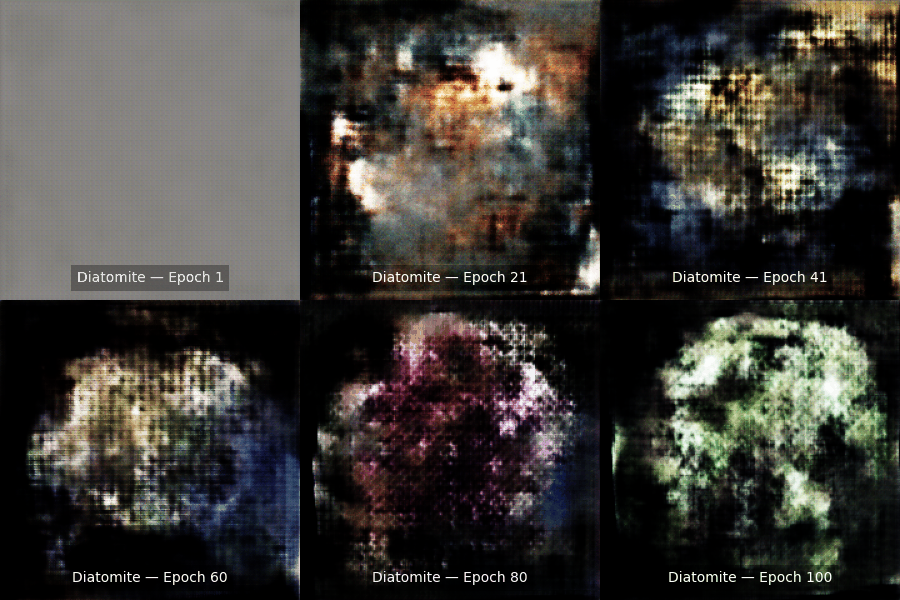
Conditioned recurrent model Two static conditions are independently encoded into state vectors, concatenated, and mapped to the initial recurrent state. The RNN uses this conditioned initial state together with time-series inputs to predict reservoir releases. CONDITIONED RECURRENT MODEL Conditions Encode Combine Initial state c1 c2 W1 W2 W3 s0 RNN Time-series inputs Releases MSc thesis Modelling Historical Reservoir Releases with Recurrent Deep Learning Methods Recurrent deep learning models for reconstructing historical reservoir release behaviour, with an interactive results explorer. Deep learningHydrologyRNNs SATELLITE / GROUND OBSERVATIONS BSc thesis Predicting Particulate Matter Concentrations from Satellite Data Using Machine Learning A machine learning investigation connecting satellite observations with ground-level particulate matter concentrations. Machine learningRemote sensingAir quality RockGAN-generated diatomite samples evolving throughout training Project RockGAN A conditional generative adversarial network for producing synthetic images across nine rock classes. TensorFlowKerasComputer vision

MSc thesis

Historical reservoir releases

Modelling historical reservoir releases using recurrent deep learning methods. The project compares architectures and configurations across in-test and held-out reservoirs.

Open the integrated results explorer

BSc thesis

Satellite-derived particulate matter

Predicting particulate matter concentrations from satellite data using machine learning. The work connects a geoscience and physics background with air-quality monitoring and applied modelling.

The thesis document is not published online.

Project

RockGAN

A conditional GAN built with TensorFlow and Keras to generate synthetic images for nine rock classes. The repository includes training code, a notebook workflow, and visual comparisons of real and generated samples.

View the GitHub repository